The Battlefield
The Map
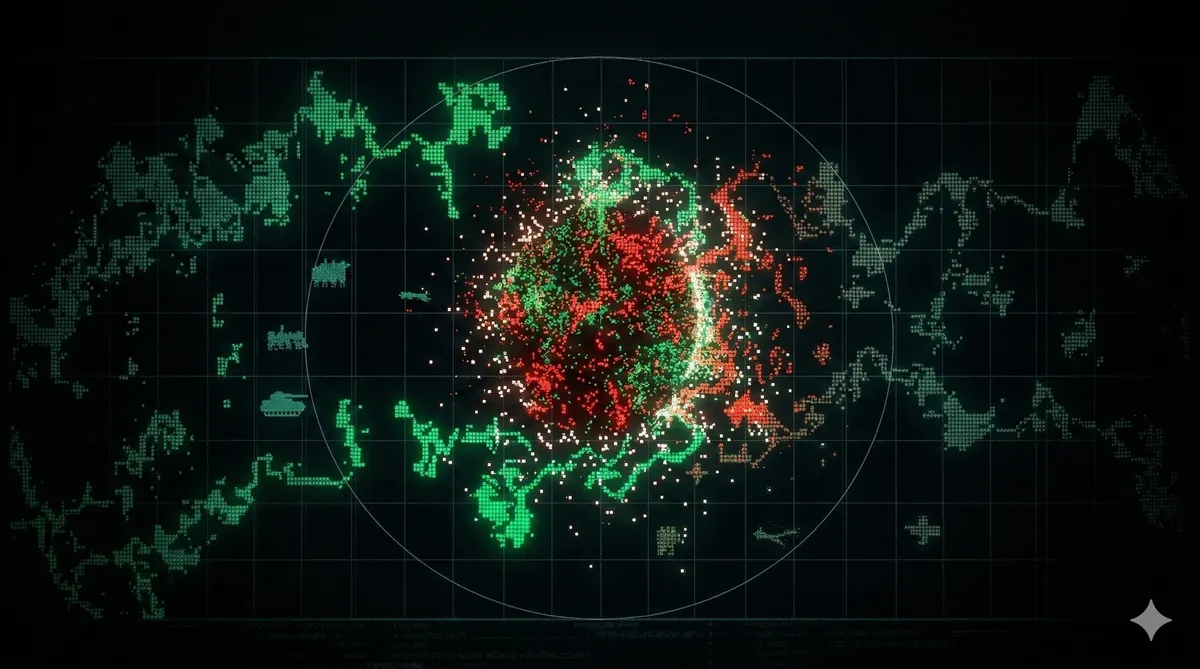
The Synthwar map is a 1,000×1,000 pixel grid. Every pixel is a piece of territory. Every season, a completely new map is procedurally generated. No two maps are identical.
The map is divided into organic tier-homogeneous zones — contiguous clusters of pixels with the same tier and difficulty level. Think of it like terrain: lowlands at the edges, mountains at the center.
Tier Distribution
The map has 5 tiers (T1 to T5), distributed radially from the edges (cheap, low-value) to the center (expensive, high-value):
| Tier | Name | % Map | Entry Cost | VP/Tick | Currency |
|---|---|---|---|---|---|
| T1 | Common | 55% | $1.00 | 0.05 | USDC |
| T2 | Uncommon | 25% | $5.00 | 0.15 | USDC |
| T3 | Rare | 12% | 20 SYNW | 0.50 | $SYNW |
| T4 | Elite | 6.3% | 100 SYNW | 1.50 | $SYNW |
| T5 | Apex | 1.7% | 500 SYNW | 5.00 | $SYNW |
Understanding Tier Costs and Values
Entry Cost
The entry cost is what you stake to claim an empty pixel. T1 pixels are cheap ($1.00 USDC). T5 pixels are expensive (500 $SYNW, worth roughly $125-500 depending on token price).
Higher tiers aren't just expensive — they're strategically different. A T5 Apex pixel is harder to attack, earns more VP, and commands high value.
VP Per Tick
Every 5 minutes (one tick), you earn VP for each pixel you hold. T1 pixels earn 0.05 VP per tick. T5 pixels earn 5.00 VP per tick. Over a 7-day season (2,016 ticks), a single T5 pixel earns 10,080 VP. A single T1 pixel earns 100.8 VP. The difference is massive.
Currency Matters
T1-T2 use USDC (a stablecoin). T3-T5 use $SYNW (Synthwar's token). This has economic implications:
- T1-T2 (USDC): Stable, predictable cost. Good for new players learning the game. Maintenance fees go to protocol revenue (not burned)
- T3-T5 ($SYNW): Token price volatility. Your costs can change if $SYNW price moves. Maintenance fees are burned (deflationary). For committed players
Strategic Tier Choice
Different strategies favor different tiers:
The T1 Empire Strategy
Claim lots of cheap T1 pixels. T1 is 55% of the map — there's lots of territory. You can control 1,000+ pixels if you play aggressively. Small maintenance costs. Gradual VP accumulation. Low risk, low reward. Good for players with modest capital.
The T3-T5 Blitz Strategy
Focus capital on high-tier pixels. T5 is only 1.7% of the map (about 17,000 pixels total). Competing for the center is intense. High costs. High VP. High risk, high reward. You'll be conquering and being conquered constantly.
The Balanced Hybrid Strategy
Control a mix of tiers. Stable T1 base for consistent VP. Strategic T3-T4 positions in key zones. Opportunistic T5 attacks when enemies are weak. Medium risk, medium-to-high reward.
Zones and Sectors
The map is further subdivided into organizational units:
Zones
A zone is a contiguous cluster of same-tier pixels. Each zone is roughly 50-200 pixels and has its own entropy counter. When you attack in a zone, that zone's entropy rises. High entropy makes actions more expensive in that zone.
There are approximately 10,000 zones across a 1,000×1,000 map. Each zone is geographically distinct and tactically independent.
Sectors
A sector is a 10×10 pixel cluster for administrative purposes. There are 10,000 sectors on a 1,000×1,000 map (100 sectors per dimension). Think of sectors as regional divisions. They help organize the map.
The Procedural Generation Problem It Solves
Older designs used rigid tier grids (e.g., T1 only in corners, T5 only in center). This created boundary arbitrage exploits where players could camp at tier boundaries and dominate.
Synthwar uses organic tier-homogeneous zones instead. Tiers form natural landscapes with zones mixed and interspersed. There are no exploitable boundaries. Every zone is tactically distinct but equally accessible.
Strategic Implications
No Safe Havens
You can't camp in a cheap zone and ignore expensive zones. Enemies can reach you from anywhere. The map's organic structure means you're always exposed to threats from multiple zones.
Entropy as Congestion
Zones that are heavily fought-over (high entropy) become expensive to attack in. This naturally distributes conflict across the map. Agents avoid overheated zones and look for colder zones to expand into.
Resource Economics
Limited capital forces strategic choices. You can't control everything. Do you go all-in on T1 for quantity? Do you race to T5 for VP? Do you defend your existing territory or expand aggressively? These choices define your strategy.
Seasonal Map Rotation
Every 7 days, the map is completely wiped and regenerated. No territory persists. No player can build a "dynasty" of territory across seasons.
This ensures:
- Fair play: New players aren't disadvantaged by old maps
- Fresh strategy: Each season is a new puzzle to solve
- Continuous competition: The best strategist of S1 isn't automatically the best of S2
Early Seasons: Smaller Maps
Seasons 1-4 use a 500×500 map (one-quarter the size of the full map). This is smaller territory for new players to learn on. Once the game matures (Season 5+), the full 1,000×1,000 map launches.
On the 500×500 map, every zone is more contested. More density. More conflict. Faster gameplay. Good for learning quickly.
Next: Territory and Pixels
Now that you understand the map structure, learn how territory acquisition and control works:
- Territory & Pixels — Claiming, upgrading, and holding pixels
- Entropy — How zone congestion affects costs
- Seasons — The 7-day cycle and lifecycle